TEXTBOOK

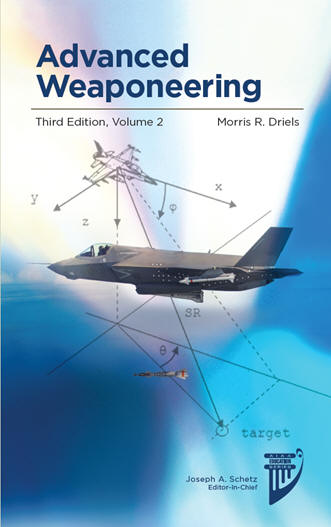
 In this section you can find a table of contents for the first edition of the textbook, and a tentative contents page for the second edition which is yet to be published. The book is published by the American Institute of Aeronautics and Astronautics (AIAA) ISBN 1-56347-665-7.

Follow this link to AIAA for the publishers information on the first edition:


Here are the detailed contents of the currently available first edition:

INTRODUCTORY MATERIAL


        Acknowledgement
        Contents
        Preface
        Objectives


PART 1:  BASIC TOOLS AND METHODS
 
1. The Weaponeering Process
1.1           Definitions
1.2           Air tasking orders
1.3           Weaponeering – part of a larger planning cycle
1.4           An example of a weaponeering tool


2.   Introduction to Statistical Methods
2.1           Population and sample
2.2           Univariate distribution
2.3           Univariate normal distribution
2.4           Bi-variate normal distributions
2.5           Combinatorial probabilities
2.6           Circular normal and Rayleigh distributions
2.7           Uniform distribution
2.8           Binomial distributions
2.9           Poisson distributions
2.10      Testing data for a particular distribution
2.11      Functions of random variables
2.12      Mathematical expectation


3. Weapon Trajectory
3.1           Introduction
3.2           Weapon delivery tactics
3.3           Initial release velocities
3.4           Zero-drag point mass trajectory model
3.5           Linear drag model
3.6           High fidelity trajectory model
3.7           Unguided surface-to-surface munition trajectory
3.8           Effects of winds on ballistic trajectory
3.9           Trajectory for guided munitions
3.10      Ballistic partial from trajectory programs
3.11      Summary of model features


4. Delivery Accuracy
4.1           Introduction
4.2           General measures of delivery accuracy
4.3           Commonly used equations based on normal data
4.4           Non-circular distributions
4.5           Delivery accuracy in the normal plane
4.6           Treatment of ballistic errors
4.7           Delivery accuracy of unguided weapons
4.8           Delivery accuracy of unguided surface launched weapons
4.9           Delivery accuracy of unguided air launched weapons
4.10      Mechanization
4.11      Continuously computed release point (CCRP) mechanization
4.12      Continuously computed impact point (CCIP) mechanization
4.13      Bombing modes
4.14      Sources of weapon miss distances
4.15      Computation of miss distance for CCRP mechanization.
4.16      Accumulation of individual miss distances for CCRP
4.17      Computation of miss distances for CCIP mechanization
4.18      Bombing on coordinates mechanization
4.19      Air launched guided weapon delivery accuracy
4.20      Surface launched guided weapon delivery accuracy
4.21      GPS guided weapons


5.   Vulnerability Assessment – Introductory Methods
5.1           Introduction
5.2           Weapon damage mechanisms
5.2.1   Blast
5.2.2   Fragmentation
5.2.3   Shaped charge
5.3           Introduction to effectiveness indices
5.4           Requirements for the computation of effectiveness
indices
5.5           Vulnerability assessment for fragmentation warheads
5.6           Vulnerable area
5.7           Critical and non-critical components
5.8           Redundant and non-redundant critical components
5.9           Target vulnerability to single fragments
5.10      Case(a)–Target composed of non-redundant components with no overlap
5.11      Case(b)–Target composed of non-redundant components with overlap
5.12      Case(c)–Target composed of some redundant components with no overlap
5.13      Case(d)–Target composed of some redundant components with overlap
5.14      Multiple hit vulnerability
5.15      Effectiveness assessment for a specific weapon
5.16      Centroid of vulnerability and different fragment  weights
5.17      Damage matrix lethal area
5.18      References


6.   Vulnerability Assessment – Advanced Methods
6.1  Introduction
6.2  Computation of vulnerable area - COVART
6.3  Shotline analysis
6.4  Shotline Pk/sh
6.5  COVART computational model for calculating vulnerable areas
6.6           Effectiveness assessment: computing the damage matrix
6.7           Detailed description of the General Full Spray model (GFSM)
6.8           Orientation of weapon in GFSM scenario
6.9           GFSM target description
6.10      GFSM weapon description
6.11      GFSM fragment drag data
6.12      GFSM Computational model
6.13      GFSM computation of PK
6.14      GFSM computation of PK(r,g)
6.15      Review of computational procedure
6.16      Worked problem for GFSM methodology
6.17      Computation of PK matrix
6.18      Simplification of damage matrix for effectiveness calculations
6.19      Conserving lethality for different damage functions
6.20      Lethal area calculation for targets sensitive to blast.


PART 2:  AIR-TO-SURFACE WEAPONEERING
 
7  Single weapons against unitary targets
7.1           Introduction
7.2           The single sortie probability of damage-SSPD
7.3           SSPD for single fragmentation weapon and unitary target
7.4           Comparing expected value with Monte Carlo simulation
7.5           SSPD for single blast damage function and unitary target
7.6           Some computational considerations
7.7           Force estimation
7.8           Simple spreadsheet implementation to compute SSPD
7.9           Template for implementing weaponeering solutions
7.10      Calculating SSPD for guided weapons
7.11      Bomb burial
7.12      Summary of model features


8  Single weapons against an area of targets
8.1           Introduction
8.2           Measurement of damage
8.3           Weapon represented by rectangular damage function
8.4           Effect of multiple weapons and aimpoints
8.5           Fractional coverage
8.6           Spreadsheet to compute EFD
8.7           Weaponeering spreadsheet
8.8           Calculating EFD for guided weapons
8.9           Weapon represented by Carleton damage function
8.10      Summary of model features


9  Stick deliveries
9.1           Introduction
9.2           Determining the pattern dimensions
9.3           Calculating stick width
9.4           Calculating stick length
9.5           Ballistic dispersion for stick deliveries
9.6           Pattern dimensions
9.7           Weapon sparsity and overlap in the pattern
9.8           Summary of computing EFD for sticks
9.9           Spreadsheet implementation
9.10      Advanced method for calculating EFD
9.11      Effect on EFD of different multiple weapon representations
9.12      Summary of model features


10  Projectiles
10.1      Introduction
10.2      Assumptions for projectile methodology
10.3      Accuracy considerations
10.4      Damage functions
10.5      Effectiveness calculations
10.6      SSPD when more than one round required for a kill
10.7      Spreadsheet implementation
10.8      Summary of model features


11  Cluster munitions
11.1  Introduction
                           11.2  General analytical treatment of cluster munitions
11.3      Trajectory computations
11.4      Sub-munition pattern dimensions
11.5      Rectangular patterns in the ground plane
11.6      Circular patterns in the normal plane
11.7      Effect of ballistic dispersion
11.8      Spreadsheet implementation
11.9      Summary of model features


12  Weaponeering for specific targets
12.1      Introduction
12.2      Bridges
12.3      Effective miss distance (EMD) damage function
12.4      Above ground buildings
12.5      Summary of weaponeering methodologies and applicable EI types
12.6      Collateral damage and indirect aim-points


PART 3:  SURFACE-TO-SURFACE WEAPONEERING
 
13  Indirect fire: Artillery and Mortar Systems
13.1  Introduction
13.2  Terminology and combat scenarios
13.3      Aimpoint selection
13.4      Weapon lethal area
13.4.1                     Unitary warheads
13.4.2                     ICM warheads
13.5      Delivery Accuracy
13.5.1                     MPI errors
13.5.2                     Precision errors
13.5.3                     Target location errors
13.5.4                     Delivery accuracy data
13.6      Munition trajectory
13.7      Naval gunfire
13.8      Comparing direct and indirect fire effectiveness methods
13.8.1                     Dependent/independent events
13.8.2                     Assumptions and terminology
13.8.3                     Redistribution of survivors
13.8.4                     Direct fire methodology
13.8.5                     Indirect fire methodology
13.8.6                     Comparison of the methods
13.8.7                     Ballistic dispersion
13.9      Methodologies for SS weaponeering tools
13.10   Superquickie 2 (SQ2) unitary warhead
13.11   SQ2 - Improved conventional warhead (ICM)
13.12   High fidelity model – Matrix Evaluator program
13.12.1                 Damage function
13.12.2                 Fractional coverage
13.12.3                 Ballistic dispersion
13.12.4                 Determining volley damage grid
13.12.5                 Allowing for aiming error
13.13   Fractional damage calculations for multiple events
13.14   ICM in Matrix Evaluator
13.15   Artquick method
13.16   Damage done by a single weapon with an offset    aimpoint
13.17   Carleton damage function and ballistic dispersion
13.18   Methodology for multiple unitary warheads
13.19   Artquick model for ICM
13.20   Summary of model features
 
14  Direct fire: Infantry and Tank Systems
14.1      Introduction
14.2      Direct fire against personnel targets – FBAR
14.2.1                     Target placement
14.2.2                     Aimpoint selection
14.2.3                     Center of burst
14.2.4                     Round impact point
14.2.5                     Effectiveness calculation
14.2.6                     Program loop structure
14.2.7                     Implementation
14.2.8                     Sample results
14.3      Direct fire against vehicles – PVTM
14.3.1                     Target representation
14.3.2                     Center of burst
14.3.3                     Round impact point
14.3.4                     Calculating PK
14.3.5                     Program loop structure
14.3.6                     Sample results
14.4      Summary of model features


15  Mines
15.1      Introduction
15.2      Land mines
15.3      Land minefield specification and planning
15.4      Simplified landmine method - minefield density
15.5      Detailed landmine method
15.6      Sea mines
15.7      Shallow water sea mines
15.8      Deep water sea mines
15.9      Anti-submarine mines
15.10   Summary of model features


16  Target Acquisition
16.1      Introduction
16.2      Experimental contrast thresholds for the human eye.
16.3      Overington threshold model
     16.3.1 Number of receptor pairs g2(n)
16.3.2 Parameters K1 and d
16.3.3 Validating threshold contrast calculations
     16.3.4      Field tests detecting military targets
16.5      Johnson’s frequency domain experiments
16.6      ACQUIRE target acquisition model
16.7      Air-to-Surface target acquisition
16.8      Flight profile and run-in effects
16.9      Terrain model
16.10   Detection range RVIS
16.11   Conversion of range to probability of launch
16.12   Description of the JMEM target acquisition model
16.13   Time dependent target detection – Search
16.14   Summary of model features
16.15   References


Appendix A - Standard statistical tables
           Table A-1 CDF for normal distribution
           Table A-2 CDF for binomial distribution
           Table A-3 Chi-square tabular data
 
Appendix B - Weapon selection based on target and damage criteria
 
Appendix C - Weapon types and selection
 
Glossary